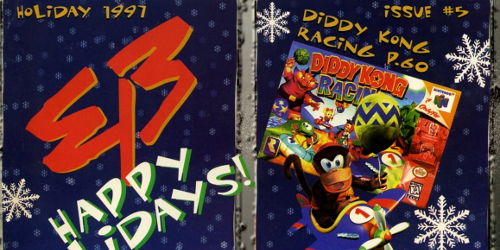
November 1997: The Christmas Job, Again

I had a year of college knocked down and things were going great. Well, not financially great. Christmas was approaching and I needed to be able to afford a few gifts for my girlfriend (future wife). Since the semester ended early in December I knew I could pick-up a temporary retail job. An EBGames store was the perfect fit. I applied for a seasonal post and was hired in a second. They were happy to have someone that not only didn't require training but could actually train the other Christmas help.
In 15 months a lot had changed, more than just the name. The first thing I noticed was a new register system. The new system ran on top of Windows 95 and had a game reservation system built-in. This was a nice change from the amber screen terminals and giant reservation binder. The game selection had obviously evolved too. Genesis and Super Nintendo were relegated to a preowned bin, the Saturn was nearly invisible. The PlayStation and Nintendo 64 were duking it out for system dominance and Sony had the upper hand.
Earlier in 1997 EBGames introduced a "preferred buyers card". For $30 a year you'd get 5% off all purchases (hardware excluded). In case you can't do the math, it would take $600 of games to break even. When we tried to sell it we used the phrase "one $50 game a month" because it sounded better. Kinda like how infomercials will say "four easy payments of $70" instead of "this piece of crap costs $280". These cards were only the second item we were offered a commission on. EBGames knew the average buyer wouldn't come near the $600 mark so they wanted to sell as many as possible.
The one thing that didn't change was the customers. The thing I remember best about this time was a parent looking for "Residential Evil", classic.

Something about this Christmas season felt off. There was no "must have" game out. GoldenEye for the Nintendo 64 was the top seller of the season but there wasn't a "buzz" around gaming this year. The store was busy of course but not like previous years. There wasn't a mega-smash-hit game or epic battle of gaming platforms. It just felt, well, average. Even the highly anticipated Quake II launch seemed bland. For about two days it sold like crazy but then dropped off. Maybe a nearby competitor was selling it cheaper, maybe it was being pirated left & right, whatever the case its sales flattened shortly after the release.
In January of 1998 I started working as a Visual Basic programmer, signaling my exit from retail. I wasn't even finished with college yet but had a pseudo-real job. Software companies were so desperate for help that they didn't care if prospects had a degree or real experience. I knew VB well enough to breeze though a technical interview, although in hindsight I wasn't yet fully qualified for the type of work thrown at me. A company desperate enough to hire an under qualified programmer also didn't care if that programmer worked 2:00-10:00 PM. There was another guy in the same situation as me, going to college full-time and coming in to crank out VB code at odd hours. We got a lot of work done so nobody really cared. There was a very reckless mindset across most of IT in that brief era. Needless to say, this company is no longer in business.
In 2005 I attended a Microsoft sponsored ASP.NET/SQL Server security event in the Milwaukee area. On the way home I stopped by Bayshore Mall to check out the old place. Apparently it's undergoing some kind of renovation now but clearly wasn't at the time. The Waldensoftware was long gone, replaced by an EBGames in a small location off the food court. Instead of being filled with toxic nail salon fumes it had the lingering aroma of many fast food items mashed together. That gag-inducing blend of burgers, fries, pizza, imitation Chinese cuisine, and overflowing garbage cans. I shivered at the thought that I could still be working there.
I still visit the EBGames (now a GameStop) at Gurnee Mills often but rarely buy games anymore. Most of my free time is occupied by (slightly) more productive hobbies. There's a second GameStop in the mall that used to be a Software Etc and I still wonder if the merger will result in one or the other closing. Although it's not the largest mall in the country anymore, it's still big enough to support both.
Some readers may think I was a tad harsh on retail employees in this little article, that was not the intention. I do poke fun at the "career" employees, which are different than a true career retailer. What's the difference? Being a regional or district manager, managing a Home Depot, or owning your own store are all examples of having a retail career. These all require a college degree and actual management skills. A 20-something college dropout who calls their mall job a "career" to make it sound like they're doing something with their life is, well, a loser. I've met many, many more of the latter.
Retail is fine as a part-time job under the right circumstances. You're guaranteed to work indoors with minimal manual labor, there's probably an employee discount. It's not a bad gig. If you have a real job and want to earn a few extra bucks for a big purchase, go ahead and work retail a couple evenings. If your spouse has a real job and you want to be home in the afternoon for your kids, take a job at the mall from 8:00-3:00. If you're in college full-time, a retail job will fit nicely around your class schedule. The target of my criticism is the above mentioned 20-something. While I criticize, I also genuinely hope they have an epiphany of their own that guides them on to better places.
Extra: Video Game Retail Misconceptions
Here are a few common misconceptions about video game retail that didn't fit anywhere else:
Misconception: Items that are featured prominently in a store are the highest-sellers.
Reality: Retail stores lease prominent shelf space (end-caps, front of the store displays) to vendors. The first I remember Elbo doing this was in 1993 or 1994. By 1996 nearly all the high-profile space was reserved. It continues today, for example if you walked into an electronics store in late 2005 or early 2006 you might think that UMD movies were selling like hotcakes.
Misconception: An individual retail store has direct control of their inventory.
Reality: The inventory for chain retail stores is controlled by a home office distribution system. The home office may adjust a particular store's inventory to meet local market conditions but the store staff has little to no input on the matter. Vendors themselves also control the supply of their products; stores can't sell more than what a manufacturer produces. The crappy bookstore I worked at from late 1996-1997 was the opposite case, but that company is out of business now.
Misconception: The staff at a video game store knows some secret information about release dates that's being kept from the public.
Reality: This was the most painful misconception I encountered at Elbo. We received 10-20 phone calls a day from customers looking for release dates. At least half of those ended with the caller challenging the answer we gave, as though we were hiding something from them. The worst phone call I ever had ended with the caller asking "do you not know the release date or are you not telling me because I'm black?", I simply replied "how do I know what color you are over the phone?" The information that came down from home office was based on the same sources that magazines and web sites used. There was no secret channel of communication from the vendors telling us when their games were arriving. Release dates were always subject to change anyway. Calling the store is a waste of both your time and theirs.
Misconception: Employees at a video game store have played every game on the shelf and have comprehensive knowledge about every product there.
Reality: Employees have played under 10% of the games at the store. Let's face it, on $7-$15 an hour you're not buying a lot of games. The answer to "have you played [insert game title]?" is always "yes" but that's the result of wanting to seem l33t or make a sale.
Misconception: Employees at a video game store make a commission on sales.
Reality: Usually false. Commissions are typically earned on extended warranty sales but not on merchandise. The retail markup on new video games is actually quite low, zero on hardware, so it's not economical to pay commissions. I can't speak for every store on this though.
Misconception: If you nag enough, the guy behind the counter can hook you up with a discount.
Reality: Nope. At a corporate owned store the employees can not negotiate prices. Giving an unauthorized discount is grounds for termination. No amount of begging, or even yelling, will earn you a special deal of any kind. Once or twice we had organizations that wanted to make extremely large purchases, like for a new rec center, and asked for a volume discount. Those sales had to go through the home office.
Misconception: Buying an item at a store obligates them to provide technical support.
Reality: This was a huge problem from 1992-1995 when Elbo sold more computer hardware (by 1996 it was only a few items). Many customers that had problems would call us for help based on the "you sold this to me so you have to help me" premise. If the dude working at Elbo knew how to configure IRQ/DMA, install Windows, or recover data from a fried hard drive he wouldn't be working at Elbo.
The article "28 Confessions of a GameStop Shift Supervisor" shares, and expands, on a number of these misconceptions. It's a good read if you liked this piece.
Extra: Then and Now
As a semi-regular GameStop customer, I've noticed quite a few changes since my time there (well, not at GameStop but you get what I mean). Some are for the better and others I just don't get. Here's a little comparison of then and now:
Dress Code
Then - Employees were required to dress business casual - slacks and a button-down shirt. Managers were encouraged to wear ties. I once was reprimanded by a district manager for wearing a Henley shirt (which were strangely in fashion in the mid-90s). He really earned his $35K a year that day.
Now - GameStop employees are virtually indistinguishable from Hot Topic employees. This is just fine, the old dress code was asinine. It's a store filled with games about carjackings and staving off zombies, do customers really expect the staff to look like preps?
Used Game Acceptance Policy
Then - We were only allowed to take games that included the box and instructions at first. It eventually was loosened to accept cartridges in good condition without a box for a discounted rate.
Now - The policy is roughly the same as when I left same except now for certain systems, the DS and PlayStation 2 at least, they outright chuck the box if it has one. I'm sure it's done to save space but it would have been practically unthinkable in the early days of trade-ins.
Display Boxes
Then - We always took great care in maintaining the condition of display boxes. It was policy to shrink wrap all display boxes before putting them on the shelf. It cost time and money to do that but kept them in good condition for when a customer purchased the game.
Now - Your new game will come in box that looks like a hobo lived in it. I've actually not purchased games from GameStop because the only new copy was in worse condition than a used game.
Phone Calls
Then - As noted on the first page - the internet was far from being in every household. The only way to find out game release dates was to call the store and ask. And call they did, we easily received 20+ phone calls a day asking questions that can now be answered by Google in seconds.
Now - Strangely every time I enter a GameStop I still hear the phone ringing off the hook. Seriously, what is your problem people?
Midnight Launches
Then - In my time there we never had one single midnight launch. Never even considered it, never heard of a single location that did it either. Same goes for opening at some obscene hour the day after Thanksgiving.
Now - Midnight launches are now common, as is opening way too early on the day after Thanksgiving. I bought a GameCube at launch from EBGames and they did not do a midnight opening for that either. So this practice was still not entirely common until after 2001.
Store Locations
Then - Electronics Boutique only opened in enclosed shopping malls. Standalone or strip mall locations were unheard of. Waldensoftware stores were only open in malls that already had a Waldenbooks. Software ETC and Babbages, which were also consumed by GameStop, were also exclusively in shoppings malls. Only Funcoland, also GameStop now, braved the great outdoors.
Now - GameStop stores are in every type of retail environment you can imagine.
Product Selection
Then - The inventory at each store location was different based on the demographics of the area and historical sales. For example, some stores would have large selections of Mac software while others would have none.
Now - Based solely on personal experience, it seems that all GameStop locations have almost exactly the same inventory.
Devotion to Accuracy
This article was authored from 10-14 year-old personal recollections. The content of this article was verified to the best of my abilities. Nothing in this article is deliberately false or exaggerated. I'm not nearly creative enough to make this kind of stuff up. Any confirmed inaccuracies will be corrected immediately.
The following sources were used to fact check this article:

I turned 21 in 1996. As a result there's a lot of missing time that year. Luckily, I had an old CD laying around labeled "EB Spring '96". It was a disc we gave away at stores (sponsored by Prodigy) that contained a mail-order catalog of every item we stocked. I used this CD as a reference for the 1996 page.

Although I found this Electronics Boutique Spring 1993 Catalog after I wrote the first version of this article it's still a great reference for understanding the year 1993 in gaming.
The following Wikipedia articles were used to verify facts and release dates:
See https://www.wageaccess.com/ncs/retail.asp for information on retail wages. The numbers I quote are based off a mix of personal experience and the statistics on that site. The ranges they quote don't breakdown salary by store size, type, or required level of education. For example, someone managing a Wal-Mart or Sears makes substantially more than someone managing a GameStop or Hot Topic. Since the skills required to manage a large store are harder to find than for a smaller store it's only logical.
Conversations in this article are obviously not the exact exchange that occurred. They are based on actual events and reflect the demeanor to the best of my recollection. I intentionally refrained from using real names because of this.
Thanks to thomas80 for the correction on how many disks shipped in the Windows 95 package.
Thanks to Claudio for the correction on which countries in South America use PAL vs. NTSC.
Thanks to Chris F. for links to the YouTube videos of the Jennifer Aniston & Matthew Perry Windows 95 Guide.
Thanks to Dereck W. for a DriveSpace/DoubleSpace correction.
Related