April 1995: Trading Cards

Around this time is when Electronics Boutique started aggressively changing to a game store. The productivity section shrank to a few core items to make room for more games. The company, without directly saying so, was targeting the 16-29 year-old male demographic heavily. Part of this strategy included the addition of trading cards. Magic the Gathering was gaining popularity among the computer-RPG-nerd-type. Elbo capitalized on that by carrying this hot new card game. I was skeptical but proven wrong. We sold an unbelievable amount of these cards, entire boxes at a time.
This brings to mind a dumb policy that was implemented at this time - banning the use of the quantity (QTY) key on the register. Apparently some employees found it challenging to count multiple packs of cards so there was an edict to scan each pack individually to prevent discrepancies. If someone wanted to buy a sealed box of cards, which again was very common for Magic, we were expected to open the box and scan each pack inside. Customers and employees complained and we were later given separate SKUs to scan for sales of sealed boxes.
Unfortunately Elbo overestimated their ability to sell cards. Soon we were carrying a wide range of sports cards. These didn't go over well at all. The main buyer of sports cards is not a hardcore gamer, if one at all. They stop at an Elbo occasionally and do most of their card shopping at comic book stores. We also started selling Pogs. I didn't know then and I don't know now what one was supposed to do with a Pog. They were a frequent target of employee scorn and a very poor seller. These two product lines offset the success of the gaming cards. Trading cards were eventually dropped from the lineup.
Elbo participated in a "secret shopper" program used to validate customer service at their locations. These "secret shoppers" were incredibly easy to spot because everything they said was over-scripted. While Elbo morphed into a gaming store, no one bothered to update the "secret shopper" script. I received some negative feedback after an interaction that went like this:
SS: Hello, do you have WordPerfect 5.1 word processing software?
Me: It's up to version 6 now but I'm sorry, we don't carry it.
SS: Then can you recommend any other word processing software?
Me: We don't carry word processors anymore, I'm sorry.
SS: Could you tell me where I can find word processing software?
Me: There's an Office Depot down the street, they should have some.
Of the course the "correct" answer to the last question was "There is no place in the known universe where you can acquire software like that. How about a copy of the latest Sonic the Hedgehog game instead?" Yeah, there was a guideline that you should never, ever send a customer to another store regardless of what they were looking for.

Early in 1995 we had a visit from then CEO J.J. Firestone (no idea if he's related to the founder of the tire company). We had about a week's notice and cleaned the store up until it was in mint condition. The visit itself was a minor letdown. He walked around for about 5-10 minutes while talking with our regional manager. He also said hello to our store manager but didn't talk much. Our manager was visibly disappointed by the visit, expecting the CEO to be a little more enthusiastic. Mr. Firestone had a great mind for the retail industry. Under his watch the company experienced it's greatest period of growth. Going out and visiting the field wasn't really his forte.
Many years later I'd gain some perspective on this visit. I was working at the home office for a large company, much larger than Elbo. Every couple of months the CEO holds a "town hall" meeting where he speaks for 30-45 minutes and then takes a few questions from employees. Without fail, someone asks a question like "Why don't we have more microwaves in the cafeteria, there's always a line to use them?" It takes incredible will-power for me to stop myself from yelling "He's the CEO of a multi-billion dollar company, he doesn't give a crap about your petty microwave grievance! You sound like a whiny moron!" He, on the other hand, always manages a cordial response. I can't imagine how tough it is to not answer a stupid question with a brutal reply. This is one of the (many) reasons why I'm not CEO material.
When the CEO of Electronics Boutique visits a store I'm sure he gets hit with equally asinine questions, only they're being asked by 19 year-old junior college dropouts. No wonder he didn't want to make eye contact with any of us.

I guess I can't talk about early 1995 without mentioning Microsoft Bob. At the same time, how much more can I add? This Windows enhancement received a lot of hype from Microsoft. They gave us the impression that this was going to revolutionize Windows, making it so easy that even a brain-dead monkey could use it. However, the packaging made it look so childish that no self-respecting person would touch it. Indeed, we received about 20 copies and sold 1-2. A couple of months later we were sent a note from home office to immediately return all copies of it. Not markdown, not return 75% of them when we got around to it, but return them all at once. Not a whole lot more to say about it.
May 1995: Sega Saturn Surprise Launch

Sega peered into their crystal ball and saw a bleak future where the Sony PlayStation dominated the American game market while Saturn consoles collected dust. That scenario was slowly unfolding in Japan. The PlayStation not only was technically superior to the Saturn, but it was cheaper and easier to develop for. They understood that drastic action was required to defeat Sony. They tried a bold strategy, a surprise U.S. launch of the Saturn console. Instead of waiting until the planned fall release they hurriedly shipped $400 systems to every game store in the country.
We literally had no warning about the surprise launch. There were rumors circulating in the morning, a few phone calls asking about it, but nothing confirmed. Around noon an Airborne Express delivery guy popped-up with a stack of Saturn consoles. At the time it was rare to receive anything directly from a vendor like that. We rushed to clear out a prominent section to display this new system.
Sony responded by immediately announcing that the PlayStation would still come out in September, only it would be $100 less than the Saturn. Consumers now had an interesting choice to make. Get the Saturn now for $400 or wait until fall for a cheaper, and potentially better, PlayStation. Some opted for the Saturn because the Sega brand was stronger than newcomer Sony. Then there was the must-have-the-newest-system-regardless-of-price-or-game-library crowd. They snatched up the Saturn right away and to this day will drop $500-$800 at every system launch.
Some folks couldn't wait for the real 32-bit systems to arrive in the states and imported them from Japan. There's one I remember well because he was one of "chronic returners". Elbo's generous return policy was often abused turning us into a de-facto rental store for some. We did have a "no returns" list behind the counter for people who took it too far. The customer I'm thinking of was on the borderline, he bought 5-6 games a month and returned 4-5 of them. I learned that he bought an import Saturn about an hour after he purchased a few launch titles from our store. The Saturn was region-locked and he came in all angry that he couldn't play American games. I experienced a brief moment of schadenfreude knowing that his impatience cost him several hundred dollars.

Those that bought the Saturn early would soon be disappointed by the lack of games.
Third party publishers were developing for a September release, even Sega could only manage a couple of games at launch.
Those that rushed to buy the Saturn were calling Elbo on a daily basis asking if/when new games were coming.
We didn't have the answer they were looking for.
Between the surprise May launch and the original September release the only new game to hit the shelves was Bug!.
This goofy platformer was a slap in the face to those that just spent a stack of cash on this new system.
It wasn't long before parallels were drawn between the Saturn and the Sega CD/32X, the once-dominant Sega finding a way to botch another new hardware platform.
Another issue with the Saturn was the extremely poor quality controllers.
They broke at a rate that made the Atari 5200 stick look downright indestructible.
We saw more defective Saturn controllers exchanged than any other.
I liked the Sega Saturn but didn't own one until my wife bought me one as a Christmas present in 2002. I've built up a small collection of "favorites" like Hexen, D, Sim City 2000, and NBA Jam. I'm hoping to get lucky and find a few more classics at garage sales or classic game conventions.
The Sega Saturn received a lot of display space at the Game On exhibit. The displays included the more durable Japanese controllers.
That summer our store "adopted" a kid named Kenny. His mom worked at a kiosk near our store. Rather than leave him home alone (he was old enough) she decided to use the free babysitting service provided by Elbo. What's that you say? You've never heard of this service? Parents regularly leave their unruly kids in video game stores while they go shopping elsewhere, it's a more common occurrence in December when they don't want their kids to see their presents. The kids will spend anywhere from 1-4 hours in the store reading magazines and re-arranging shelves. There was a legend of a kid urinating on the floor but I didn't believe it.
Kenny wasn't unruly though. He spent a good 6-8 hours a day at our store slowly reading the back of every box. I figured he knew the product selection better than anyone working there. He never got in the way or made a mess so we just ignored the situation. Sometimes he'd badger us with questions but we were good at ignoring that too.
July 1995: Waldensoftware

In 1993 Electronics Boutique entered an agreement with Borders to manage their Waldensoftware line of stores. Waldensoftware being the software counterpart to Waldenbooks. We were told that Elbo would be running the stores but they would still be owned by Borders. Our store, being an outlet location, started receiving clearance merchandise from a few Waldensoftware stores so we suspected there was more to the arrangement than a simple consultation. Eventually, Elbo would formally buy-out the Waldensoftware chain and convert them to EBGames.
When this agreement started a few experienced Elbo store managers were promoted to "area manager" and given oversight of 1-2 Waldensoftware locations. An "area manager" would manage their store four days a week and spend the fifth traveling to one of their other stores. This was different than the "district manager" who didn't run a store day-to-day and traveled 4 days a week. The manager of our store was promoted to this new "area manager" position and assigned two stores in Wisconsin.
One of these two Waldensoftware stores didn't take the arrangement well. The employees at the Bayshore Mall location grew increasingly unhappy and all quit (except for one guy who only worked Sundays and didn't care who was in charge). A team of several full-time employees from a couple Elbo stores were asked to take rotational duties working at that store until a new staff could be assembled. Being the geographically closest, but by not means "close", I was asked to go there for a few weeks. I thought it sounded like an interesting change of pace so I agreed.
Earlier in year I had to briefly work at the Elbo in Lincolnwood Mall after most of the staff was fired for some undisclosed corporate violation. There's not much to say about that store except that it's extremely small. It's also the last store in the area I'm aware of that still uses the old-school Electronics Boutique signage (as of April 2006).
If anyone thinks I'm joking about Waldensoftware staff revolts then take a look at this post I dug up from Google groups (9/1993):
WaldenSoftware and Electronic Boutique...unholy union!
Okay maybe it isnt a 'unholy union' but thats what the manager of my local WaldenSoft was saying as he is forced to remove all his business applications and precious books and replace them with a comprehensive title library for video game systems as well as current releases for computers.
It seems that WaldenSoftware's parent company 9same as WaldenBooks) has entered into an 18-month agreement with Electronics Boutique for EB to take over management of its stores. The end result being a more EB like store with emphasis on entertainment rather than business/institutional computing. Also EB has an option to bid for the Walden stores at the end of the 18-month period if it wants to fully take them over. [editor's note: this is an accurate description of the situation]
This was all heard from listening into the manager gripe while saying things like "video games... computer games...I dont play the things. I really dont have times for the stuff" I am most pleased by the change as WaldenSoft is really the ONLY (aside from Best buy's pathetic selection) place to get entertainment software around here. It was becoming annoying hearing about new releases on internet and having to wait for about a month for our 'software' store to get more than 2 copies in (which left the store before hitting the shelves) Last night they had just finished putting out Wing commander Academy, which was flying off the shelf btw, and had set up fact-sheets and boxes for DarkSun Privateer and others with current releases dates above them.
Most retail managers I've known take their jobs way too seriously, even calling them a "career". Someone managing a Wal-Mart or Home Depot can go ahead and call it a "career" but the dude making $12 an hour at the mall can't. You should take your job seriously if it's a serious job. Here's a quick test: if you quit your job how long will it take to hire and train a replacement? The real issue though is that many are just completely resistant to any kind of change in life. That's why they work the same job they had in high-school, live at home, and throw a temper-tantrum when new management takes over their store. The first paragraph of this posting absolutely nails it dead-on.
It's worth noting again that this wasn't a buyout at this point. Waldensoftware was still owned by the Borders Group. I was reminded of this early on when one of our first hires was abruptly terminated by their loss presentation team for abusing the employee discount.
July rolled around and I was asked to permanently work at the Waldensoftware store as an assistant manager. The store was a pretty hefty drive to make five days a week but I saw this as some kind of step-up in the world. Some misinformed part of my mind thought this might be the path to better things. The salary seemed OK but now I wouldn't work for three times that amount. Over the previous three years I met a lot of "career" retail employees and they also suffered from delusions of having an important job. The "manager" part of their title gave them a feeling of power and relevance. I was suffering from a little bit of that myself.
Ultimately, I took the job because I couldn't think of anything better to do. That's a pretty bad reason to do something, I think it's the number reason kids take up huffing. I was directionless and probably would have said "yes" to just about anything.
It's easy to feel like an idiot for making the decision to work at a store an hour away when I couldn't possibly afford to move closer. There was really nothing positive about it. I was inching closer to hitting rock bottom in life. I had no education beyond high school, a laughable income, and no prospects of improving either. If that's not the definition of "loser" I don't know what is.
In the end I don't regret doing it though. Along the way I made some good friends and learned a little about life. See, I'm the type that learns through experience. I'm too stupid or stubborn to listen to others (of course no one was telling me this was a bad idea either). After experiencing what life would be like without finishing school it didn't take long to do a 180.
The Waldensoftware store was a totally new climate. I was accustomed to busy location that averaged $1500-$2000 a day in sales. This location brought in $1000 on a good day. The mall itself was small and lacked any kind of a "destination" store (at the time). Sure, this gave us a lot of time to keep the shop clean and well ordered but mostly left us bored. Luckily we had 4 monitors along the ceiling of the store where we ran promo tapes or game demos to keep us sane. The promo tapes sent from vendors really did help sell games, unfortunately I lacked the foresight to save most of them.
The Waldensoftware chain was different than Electronics Boutique in a number of ways. The best comparison I can come up with is to the now defunct Egghead Software. Since it was originally managed by Borders there was a large selection of books. Elbo stores carried hint books and some of the "Dummies" line while Waldensoftware stocked a fairly thorough inventory. They also carried a wider selection of productivity software including OS/2. They were one of the hold-outs for Amiga software and even hardware. One of the first things Elbo did was slash prices on the Amiga inventory which went fast.
Some of the regular customers didn't take to this conversion well. They complained that we were changing from a software store to a video game store. It shouldn't have been too shocking, software stores like Egghead were closing down while game stores were thriving. If Waldensoftware was doing so great they wouldn't need Elbo to bail them out after all. We also had a few customers looking to special-order books which was something Walden did but Elbo didn't.
There was always some confusion about the difference between Waldensoftware and Waldenbooks. To the passer-by the stores were a little tricky to distinguish. We had some monitors in the front of the store playing game demos but the signage and color schemes were identical. I distinctly remember an incident where an elderly couple came to our counter with a stack of books from the neighboring Waldenbooks:
Me: Hi, can I help you?
Couple: We'd like to pay for these books.
Me: Umm, these are from the bookstore next door.
Couple: This is the bookstore.
Me: No, we're a different store.
Couple: No you aren't.
Me: Yeah we are, sorry.
This was quite a reality-check.
Being a smaller store we relied heavily on regular customers. The reservation lists were shorter but filled with basically the same 10-20 names. Calling the reservations and following-up was a priority there instead of "do it if you get a chance". The store in Gurnee Mills had regular customers too of course, but we didn't know them well except for which systems they owned. At this Waldensoftware we spent a good deal of time chatting with the regulars.

Two of our regular customers were very memorable, not in a good way. Luckily, I largely interacted with them over the phone.
We had a gentleman call every day to check if CyberJudas for PC had been released yet. CyberJudas was an oft-delayed sequel to the niche game Shadow President. When I say he called every day I actually do mean seven days a week, usually around the same time. He always seemed irritated when it wasn't in and we didn't have a release date for it. It's not an exaggeration to say this went on for months. Mercifully for us the game finally came in. He bought a copy but I didn't meet him until he came in to return it the next day. Apparently it didn't live up to the months of mental hype he built up.
We had another regular caller who was obsessed with sports games. He'd call whenever a new sports game was released and ask a barrage of questions about it. Things like "can you see the numbers on the uniforms", "is halfback pass a play you can choose", or "can you see what color the players' socks are". I originally thought it was a prank but received confirmation from someone who met him that it was not. I decided to experiment and see how long he'd stay on hold. Next time he called with an asinine question I said "hold on, let me check" and then timed how long before he hung up. The first time he went almost thirty minutes; subsequent trials lasted under five. He did come into the store a couple of times. There was definitely something odd about him. YouTube was >10 years away but let's just say he'd have a very cringey channel.
This page gets a couple hits per day by people searching for "how to run CyberJudas on XP" or some variant. I wonder if the aforementioned mental case is one of them? Anyway, if that's how you ended up here I'd recommend running it on a Windows 95 Virtual PC.
August 1995: Windows 95 Launch

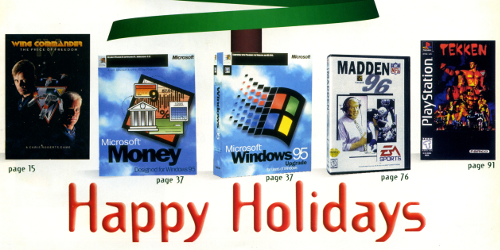
For several years Microsoft promised a new version of Windows, a version that would be a massive overhaul from Windows 3.1. They promised the removal of MS-DOS (or at least hiding it to the point no one would notice it was there). They promised a blockbuster user interface (UI) that would make computing easier. Windows 95 was to be the operating system that delivered all this. In the spring of 1995 it looked like it might slip until 1996, but by early summer we were barraged with promotional material advertising an August launch. In my years working retail this was the most heavily promoted product launch. It wasn't just for the OS, we were sent piles of books like "Windows 95 for Dummies" and promos for all the upcoming software that utilized new features in Windows 95.
Our store was sent a promo video from Microsoft that we ran on a continuous loop. The TV show Friends was starting to gain popularity so Microsoft hired Jennifer Aniston and Matthew Perry to record a ~45 minute video introducing Windows 95. It was a lot of them going "wow, you can play a CD and work on a document at the same time". I wish I saved a copy of this tape (luckily someone else did: Part 1, Part 2).
We took more pre-orders and reservations for Windows 95 than practically anything we ever sold. There was a $99 upgrade version on CD and a $200 full version on 13 3.5" disks. Oddly, we didn't carry an upgrade on 3.5" disk or a full version on CD (although both existed). I feel sorry for anyone who had to install the floppy disk version. Yeah, we did have a few customers ask for 5.25" disk editions which didn't exist. When the launch day came we weren't flooded with customers but did sell a steady stream of 5-10 an hour (which was a lot for that location).
Windows 95 was the biggest step forward in the history of Windows, period. Windows 98 was a slight improvement over 95 but was essentially the same OS. Windows ME was actually a step down from 98. Windows 2000 (my personal favorite) finally abandoned MS-DOS by running on the NT kernel. It was a giant step forward but to the average user isn't different than 95. Windows XP is just 2000 with a lot of screen real estate being wasted by oversized toolbars. Through all these iterations, the UI metaphors introduced in Windows 95 have survived. Programmers also know that the underlying UI APIs have barely changed since Windows 95.

Overshadowed by Windows 95 madness was the release of the ill-advised Nintendo Virtual Boy. Well, I suppose the release of a new line of double-ply toilet paper would have overshadowed the Virtual Boy. Never before had anything arrived in the store that made us say "there's no way we can sell this". It originally retailed for close to $200 but the price was slashed on several occasions. Were it not for the Jaguar CD this would have been the worst selling system ever. Nintendo shipped out demo units to stores hoping to spur sales. These demo units had a Virtual Boy embedded into a bulky stand, Red Alarm was the only game included. The demo unit helped a little. Some customers found it strangely addictive and bought it. The part that's still funny to me is that we were handed down strict orders from home office to not let children under 10 play it.
Any system that includes a warning with the phrase "may cause permanent eye damage to children" is doomed.
The price of the Virtual Boy went all the way down to $50 but sales never picked up. The price cuts had the opposite effect on shoppers, they now saw it as a dead system. Eventually we were told to throw out the demo units. Not "send back" but "throw out". On the way to the dumpster it took a detour to my trunk. I stupidly threw out the base because it was too big and bought a regular replacement stand for $7. I grabbed a couple of games on clearance for ~$5 but haven't played them much, it gives me a nasty headache.
September 1995: Sony PlayStation Launch
Over the summer I had the privilege of trying a Sony PlayStation before its U.S. release. To make a long story short, I participated in a test of an upcoming arcade game called Street Fighter the Movie. It was fun, a group of us battled into the wee hours of the night while developers took notes. When we were done they invited us to try a imported Sony PlayStation they had in the back. We popped in Battle Arena Toshinden and were impressed, there was no comparison between it and the Saturn. The PlayStation graphics looked crisper, more polished. The goofy-looking controller turned out to be remarkably comfortable and felt 100x sturdier than the Saturn arcade pad. Although slower paced than Virtua Fighter, Toshinden was a much better game. I remarked to one of the developers "no offense, but this blows away the game you guys just made", the nod and expression he made was a non-verbal confirmation. I immediately knew the PlayStation would be the "next big thing" in gaming.
Sony saturated the stores with PlayStation propaganda. Our store was covered with "URnotE" signs and ran a promotional tape on continuous loop. As a newcomer to the market they had an uphill battle. Electronics giants Phillips, Panasonic, and NEC all failed to launch their CD system in the US; Sony had no intention of joining their club.
September 9th was the advertised launch date. Unlike every other dated release, this was written in stone. We had extremely clear instructions to not sell the console one second before then at the risk of it being pulled from our chain by Sony. A couple customers asked if we'd open at midnight to sell it. The idea was so foreign to us that we didn't consider it for a second, contrast that to the midnight madness for modern console releases.
The Sony PlayStation launch was the most important console launch I witnessed first-hand. Except for the NES (which saved the gaming industry following the infamous 1983 crash), the Sony PlayStation has had the biggest impact of any system on gaming. The NES, Super Nintendo, and Genesis sold millions of units but video games were seen as largely a kid's toy until the PlayStation came around. The PlayStation truly broke the barrier of mainstream acceptance and its direct descendants continue to dominate gaming.
Sony did their homework. They learned from every successful, and more importantly failed, console launch before them. If anyone reading this is thinking about creating a new game console, here's what Sony did right:

One early adopter of the Sony PlayStation was Glenn "Big Dog" Robinson, then of the Milwaukee Bucks. He bought a PlayStation and a number of games from our store but was by no means a frequent customer. He always paid in cash, wore more gold than any human being I've ever seen, and had a posse of clingers-on following his every step. One of the more courteous customers we ever had. We never asked for autographs or pictures of him shopping at our store or anything like that.
One day I was talking with another employee about him a couple minutes after he left, some thing like "hey, Glenn Robinson was here again". A kid interrupted our conversation:
Kid: Did you say Glenn Robinson was here!?
Me: Yeah, he buys PlayStation games from time to time.
Kid: Did he buy NBA Live '96?
Me: Why would he buy NBA Live '96, he actually plays in the NBA. That would be like me buying Retail Clerk '96 or you buying Annoying Kid '96.
Related